They're Paid to Help You Stay Invested.
When people think about investing, they often imagine someone sitting in front of multiple screens, trying to predict which mutual fund will deliver the highest return next year.
That's what many people expect a Mutual Fund Distributor (MFD) to do.
But that isn't really their job.
In fact, if someone promises they can consistently predict the market, it's usually worth being cautious.
A good Mutual Fund Distributor does something much more valuable.
Imagine You're Climbing a Mountain
Suppose you're planning your first trek in the Himalayas.
You have a map.
You know the destination.
You've watched a few YouTube videos.
Does that guarantee you'll reach safely?
Probably not.
An experienced guide doesn't carry you to the top.
They simply help you avoid mistakes.
They know when to slow down.
When to keep going.
When bad weather is approaching.
When people usually make poor decisions.
Investing works in much the same way.
Investing Isn't Usually Difficult.
Staying Invested Is.
Most investors don't lose money because they chose a terrible mutual fund.
They lose money because they react emotionally.
Markets fall.
News headlines become frightening.
Social media predicts the next crash.
Someone says another fund has doubled.
Panic begins.
SIPs stop.
Investments get switched.
Long-term plans disappear.
Ironically, these decisions often hurt returns far more than choosing the "second-best" mutual fund instead of the "best" one.
What Does a Good Distributor Actually Do?
Before recommending any investment, a responsible distributor is likely to ask questions such as:
- Why are you investing?
- How many years can you stay invested?
- What are you trying to achieve?
- How would you react if your portfolio fell by 30%?
- Do you already own similar mutual funds?
None of these questions predict market returns.
But they help build an investment plan that matches your life rather than someone else's.
The Best Fund for Someone Else May Be Wrong for You
Every week, investors search online for:
"Best mutual fund in India."
But there isn't one answer.
The right fund depends on the person investing.
A young professional investing for retirement may need something completely different from a parent saving for a child's education or someone approaching retirement.
The same fund can be perfect for one investor and completely unsuitable for another.
That's why investing isn't only about products.
It's also about context.
Understanding Your Portfolio Matters Too
Whether you invest through a Mutual Fund Distributor, a financial advisor or completely on your own, one question remains equally important.
What do I actually own?
A mutual fund isn't just a name on your investment app.
It's a portfolio of real businesses.
Those holdings tell you far more than last year's returns ever will.
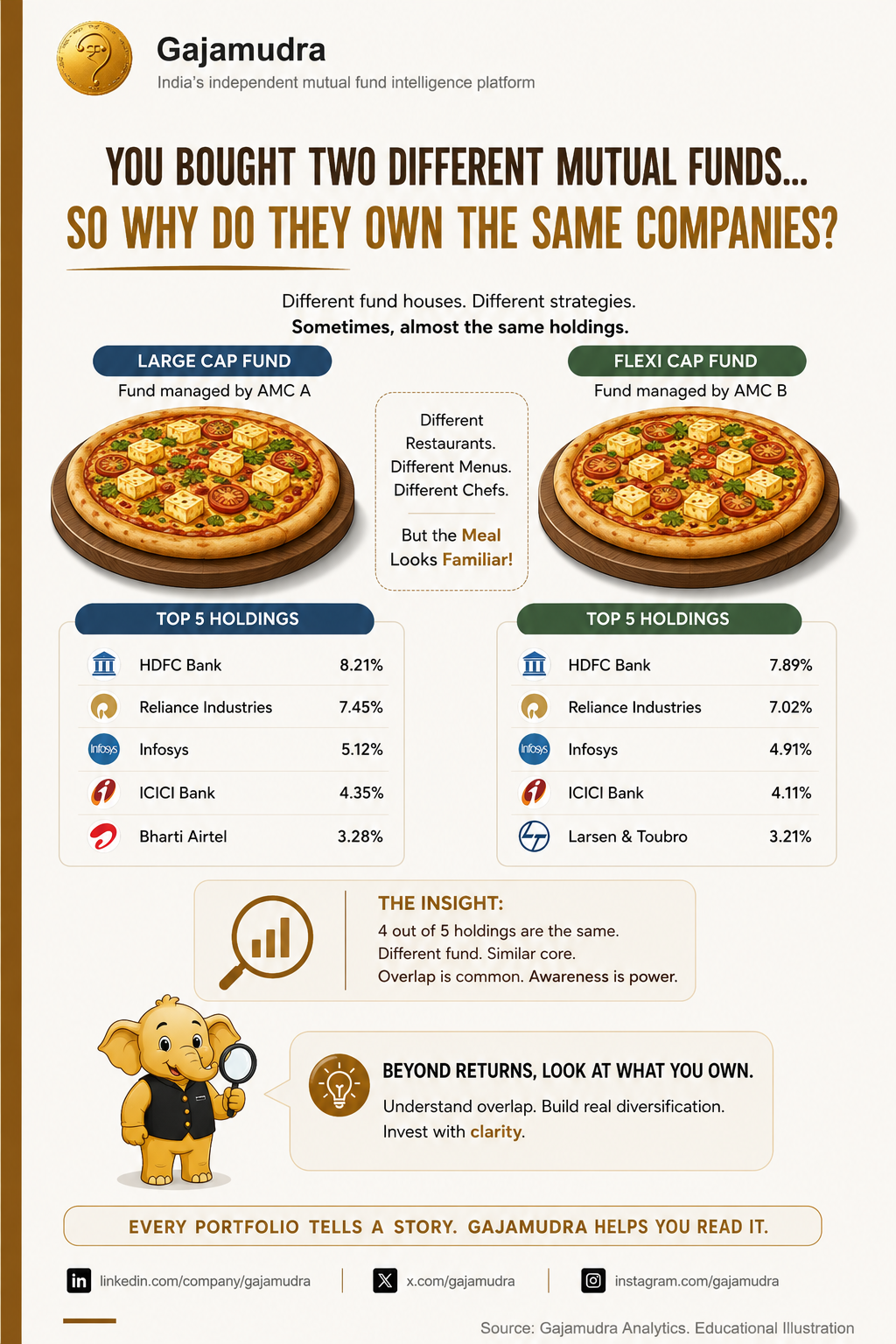
Two different funds can quietly own many of the same companies.
Without looking inside, you may think you're diversified when you're actually buying the same businesses repeatedly.
Where Gajamudra Fits In
Mutual Fund Distributors help investors choose investments that suit their goals.
Gajamudra helps investors understand what those investments actually contain.
Every month, fund houses publish detailed portfolio disclosures.
Most investors never read them.
We built Gajamudra to make those portfolios easier to explore, compare and understand.
Because better investing doesn't begin with predicting the market.
It begins with understanding what you own.
One Final Thought
Whether you invest on your own...
through a Mutual Fund Distributor...
or with a financial advisor...
don't judge your investment journey only by returns.
Judge it by the quality of the decisions you make along the way.
Sometimes avoiding one costly mistake is more valuable than finding one extraordinary investment.
Frequently Asked Questions
Does a Mutual Fund Distributor choose stocks for my mutual fund?
No. The stocks are selected by the fund manager managing the mutual fund scheme. A distributor helps investors choose suitable funds and stay aligned with their financial goals.
Is the highest-returning mutual fund always the best choice?
Not necessarily. The right mutual fund depends on your investment horizon, financial goals and ability to tolerate market fluctuations—not just recent performance.
Should I still understand my mutual fund portfolio if someone else recommends it?
Absolutely. Understanding what your fund owns helps you assess diversification, avoid unnecessary overlap and become a more informed investor.
This article is intended for educational and research purposes only and should not be construed as investment advice. Mutual fund investments are subject to market risks. Read all scheme-related documents carefully.
Beyond Returns. Understand What You Own.
Every portfolio tells a story. Gajamudra helps you read it.