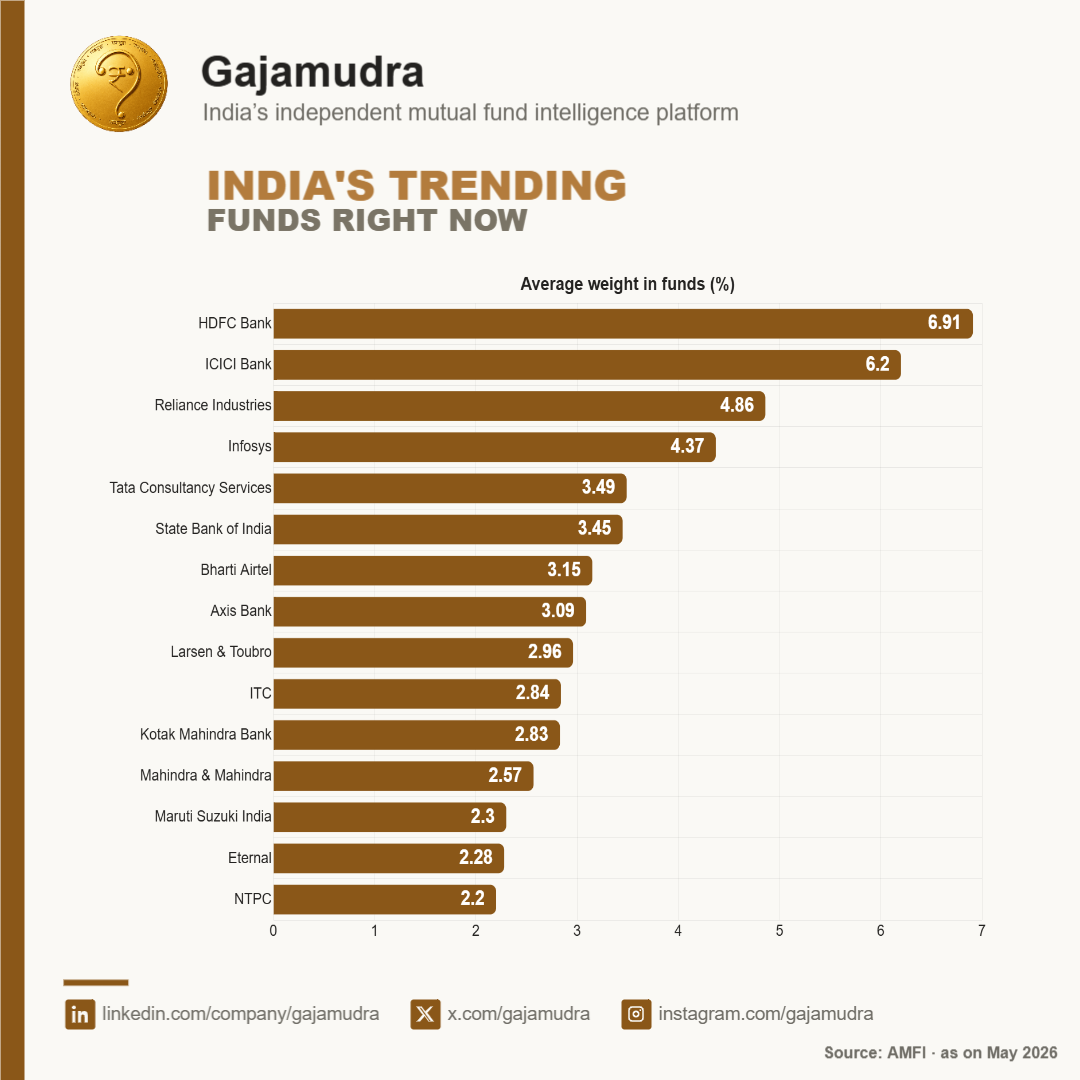
Some stocks are not just widely held by mutual funds — they are also held at meaningful weights.
This combination often signals strong institutional conviction, market leadership, and consistent relevance across portfolios. These are the names fund managers continue to rely on as core holdings across schemes.
Based on Gajamudra holdings data, these are among India’s most widely owned and meaningfully weighted stocks across mutual fund portfolios.
The most crowded stocks
-
HDFC Bank — held in 610 funds at 6.91% average weight
-
ICICI Bank — held in 562 funds at 6.20% average weight
-
State Bank of India — held in 956 funds at 3.45% average weight
-
Infosys — held in 537 funds at 4.37% average weight
-
Reliance Industries — held in 467 funds at 4.86% average weight
-
Bharti Airtel — held in 480 funds at 3.15% average weight
-
Axis Bank — held in 485 funds at 3.09% average weight
-
Kotak Mahindra Bank — held in 510 funds at 2.83% average weight
-
Tata Consultancy Services — held in 409 funds at 3.49% average weight
-
Larsen & Toubro — held in 442 funds at 2.96% average weight
-
ITC — held in 420 funds at 2.84% average weight
-
Maruti Suzuki India — held in 517 funds at 2.30% average weight
-
Mahindra & Mahindra — held in 434 funds at 2.57% average weight
-
Eternal — held in 480 funds at 2.28% average weight
-
NTPC — held in 490 funds at 2.20% average weight
Why this matters
HDFC Bank stands out at the top of the list, appearing in 610 funds with a strong 6.91% average weight. This reflects the stock’s continued importance across Indian mutual fund portfolios and the confidence fund managers place in it as a core financial-sector holding.
For a stock to appear this widely and still carry a meaningful average allocation, it usually points to more than popularity. It shows that the company has remained relevant across fund categories, investment styles, and portfolio strategies.
At the same time, when a stock is held widely across funds, it becomes useful for investors to understand portfolio overlap. Leading companies often appear across multiple schemes because of their scale, quality, and relevance. The key is not to view crowding as a negative, but to be aware of how much exposure your overall portfolio has to the same set of strong names.
Final thought
Crowding is not always a warning sign. In many cases, it reflects confidence in businesses that have become central to India’s equity market. But for investors, it is still useful to look beyond fund names and understand what they actually own.
What do you think — does high mutual fund ownership make a stock more attractive, or does it make you more cautious about portfolio overlap?
Auto-generated from Gajamudra Analytics for research and education only. This is not investment advice. Mutual fund investments are subject to market risks. Read all scheme-related documents carefully.