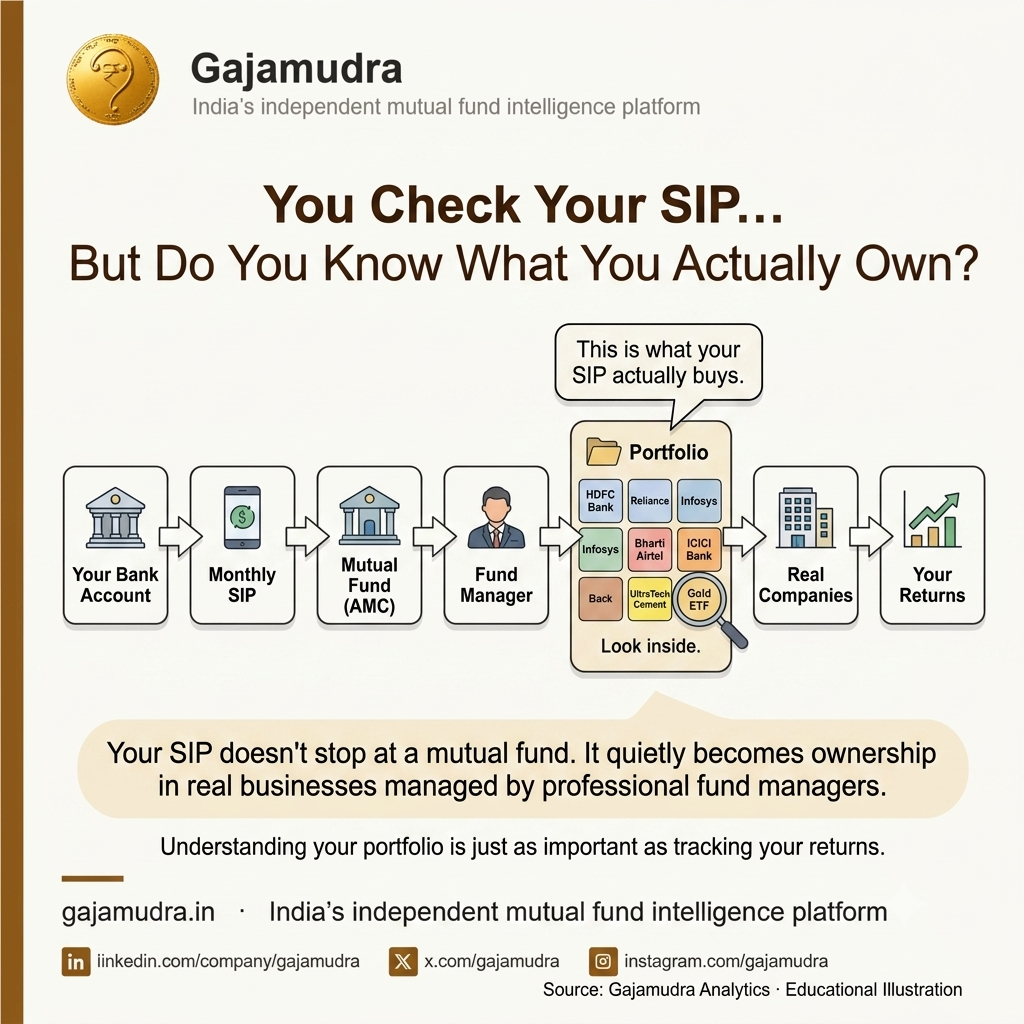
You Probably Check Your SIP Every Month…
…But There's One Thing You Almost Never Check.
Every month, lakhs of Indians open their mutual fund app.
They check one thing.
"Has my SIP gone up?"
Green numbers?
Smile.
Red numbers?
A little worry.
Then they close the app.
Month after month.
Year after year.
But here's something surprising.
Almost nobody checks what they actually own.
Think about it.
Imagine buying a grocery bag every month...
without ever looking inside.
Sounds ridiculous, right?
Yet that's exactly how many of us invest.
Your SIP Isn't Investing in "Mutual Funds"
This surprises many people.
Your money doesn't get stored in a giant box labelled Mutual Fund.
It quietly becomes pieces of real businesses.
A little HDFC Bank.
A little Reliance.
A little Infosys.
Maybe some Bharti Airtel.
Maybe even a little gold.
Every month, your money is buying tiny pieces of hundreds of companies.
But here's the interesting part...
Not every mutual fund buys the same basket.
This Is Where Things Get Interesting
Imagine two friends.
Rahul invests in Fund A.
Priya invests in Fund B.
Different fund names.
Different AMCs.
Different colours on the app.
They both believe they're diversified.
Now imagine opening both portfolios.
Surprise.
Both funds own
HDFC Bank.
Reliance.
ICICI Bank.
Infosys.
Bharti Airtel.
Suddenly...
Those two "different" funds don't look so different anymore.
This Is the Part Almost Nobody Talks About
Most investors spend hours comparing returns.
One fund gave 18%.
Another gave 19%.
But very few ask a much simpler question.
"What exactly am I paying someone to buy for me?"
Because that's what a mutual fund really is.
Someone is buying companies on your behalf.
Shouldn't you know which ones?
Reading a Portfolio Is Easier Than You Think
You don't need an MBA.
You don't need to read 100 pages.
In fact, you can understand most mutual funds in less than five minutes.
Start here.
1. Look at the first ten companies.
Those are the fund manager's favourites.
If they're doing well...
your fund usually follows.
2. See which industries appear again and again.
Lots of banks?
The fund believes in banking.
Lots of IT companies?
It expects technology to perform well.
The portfolio tells you where the manager's confidence lies.
3. Count how many companies are inside.
Some funds own 30 companies.
Others own 250.
Neither is automatically better.
One is saying
"I believe strongly in fewer ideas."
The other is saying
"I'd rather spread the risk."
4. See if there's cash.
Sometimes fund managers don't invest every rupee immediately.
They wait.
That's a clue.
Not a guarantee.
But a clue.
Here's the Biggest Surprise
Owning five mutual funds...
doesn't necessarily mean you're diversified.
If all five own the same companies...
you're simply buying the same businesses through five different wrappers.
Most people never realise this.
Until someone shows them.
That's Why We Built Gajamudra
Mutual fund portfolios aren't secret.
Every fund publishes them.
The problem is...
they're scattered across hundreds of PDFs and filled with tables that most people don't enjoy reading.
We wanted to change that.
Gajamudra brings those portfolios together, helping you understand not just how your funds performed...
but what they actually own.
Because once you start reading portfolios instead of only returns...
you begin investing with a completely different perspective.
One Last Thought
The next time you open your SIP app...
don't just ask,
"How much did I make?"
Ask something far more powerful.
"What do I actually own?"
You might be surprised by the answer.
Auto-generated from Gajamudra Analytics for research and education only - not investment advice. Mutual fund investments are subject to market risks. Read all scheme-related documents carefully.