Every new investor reaches this point.
You finally decide to start investing.
You open YouTube.
One video says,
"Mutual funds are the safest way to build wealth."
The next one says,
"Why pay fund managers? Just buy stocks yourself."
Now you're confused.
So...
Who is right?
The truth is...
Both are.
The better question isn't:
"Which one is better?"
It's:
"Which one is better for me?"
Let's understand why.
Imagine You Have ₹10,000 Today...
You have two choices.
Option A
Give the money to a professional fund manager.
Option B
Pick every company yourself.
Both options invest in the stock market.
But the journey is completely different.
Option 1: Mutual Funds – Let Someone Else Do the Heavy Lifting
Think of a mutual fund like hiring an experienced chef.
You don't buy the vegetables.
You don't choose the spices.
You don't stand in the kitchen.
You simply trust someone who does this every day.
That's exactly what happens in a mutual fund.
Professional fund managers research companies, decide what to buy, what to sell and when to make changes.
Your money gets spread across many companies instead of relying on just one or two.
The biggest advantage?
You don't need to spend hours studying balance sheets or following market news every day.
Someone else does that for you.
Of course, that expertise comes at a cost.
Every mutual fund charges a small annual fee called the expense ratio.
For many investors, it's a reasonable price to pay for professional management and diversification.
Option 2: Buying Stocks Yourself
Now imagine cooking every meal yourself.
You choose every ingredient.
You decide every recipe.
If the food turns out amazing...
You deserve the credit.
If it doesn't...
That's on you too.
Direct investing works the same way.
You choose every company.
You decide when to buy.
You decide when to sell.
You decide how much risk to take.
There are no fund management fees.
But there is something much more expensive.
Your time.
You'll need to research companies, understand businesses, follow earnings, read news and stay disciplined when markets become emotional.
Some people enjoy that.
Many don't.
Here's the Biggest Difference
People often think the difference is:
Mutual Funds vs Stocks.
It isn't.
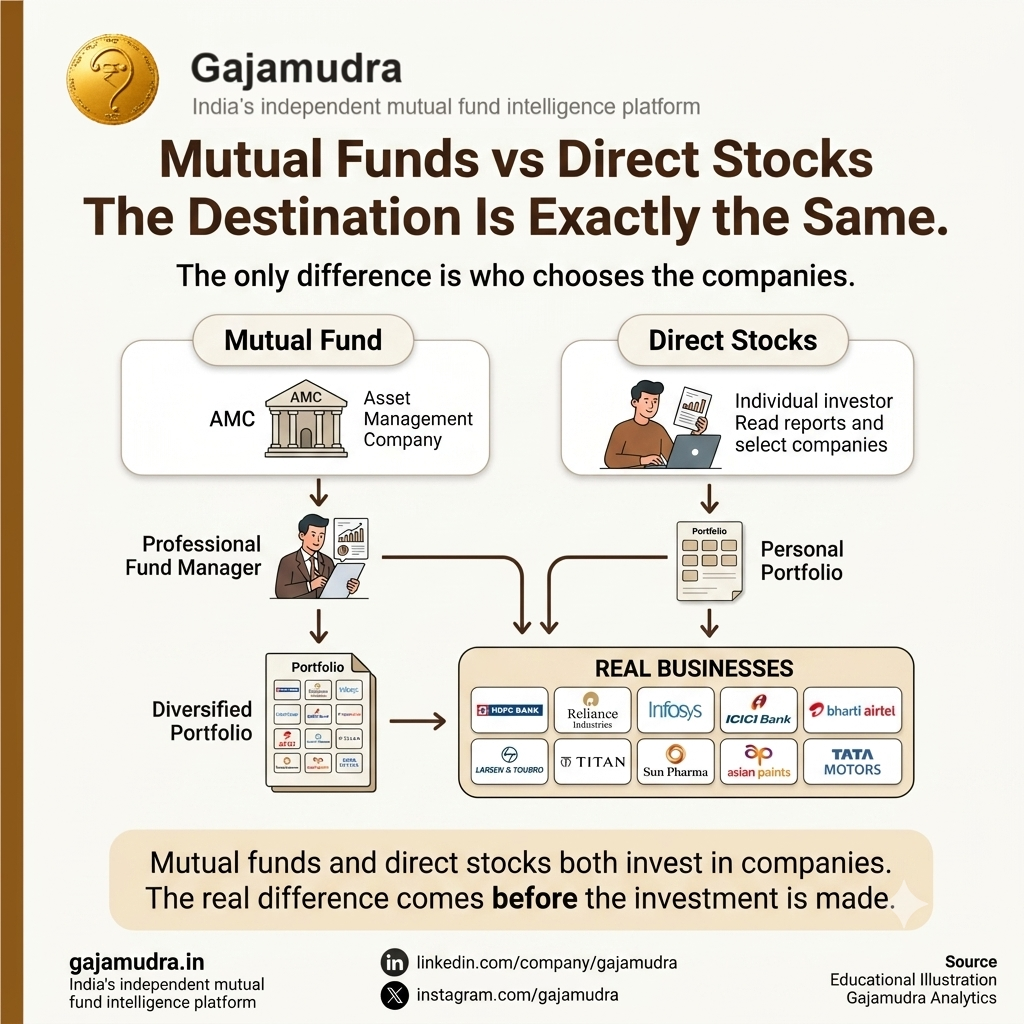
Both eventually invest in companies.
The real difference is much simpler.
Who is making the decisions?
You...
or a professional fund manager.
That's it.
So... Which One Gives Better Returns?
This is probably the most common question.
The honest answer?
Nobody knows.
A carefully built stock portfolio can outperform many mutual funds.
But it can also underperform badly if you make poor decisions or concentrate too much in a handful of companies.
Mutual funds may not always deliver the highest returns, but they aim to provide diversified exposure while removing much of the day-to-day decision-making.
Neither option guarantees success.
Good investing depends more on discipline than the investment vehicle itself.
Can You Do Both?
Absolutely.
In fact, many experienced investors do exactly that.
They use mutual funds as the foundation of their portfolio.
Then they invest directly in a few companies they understand and strongly believe in.
Think of it like this.
Your mutual funds build the house.
Your direct stocks decorate it.
The Question Most Investors Forget to Ask
Whether you invest through mutual funds...
or buy stocks directly...
one question always matters.
What do I actually own?
Many people know the names of their mutual funds.
Few know the companies inside them.
Others proudly own ten different stocks...
without understanding how all those businesses fit together.
Knowing what you own is often more important than simply owning more investments.
That's Why We Built Gajamudra Analytics
Every investment tells a story.
Mutual fund portfolios reveal which companies professional fund managers believe in.
They show sector allocations, diversification, portfolio overlap and changing convictions over time.
At Gajamudra Analytics, we make those portfolios easier to understand, compare and explore.
Because better investing doesn't begin with finding the "perfect" mutual fund.
It begins with understanding what you already own.
One Last Thought
The next time someone asks,
"Should I invest in mutual funds or stocks?"
Don't ask which one is better.
Ask something more important.
Do I want to manage my investments...
or do I want someone experienced to manage them for me?
The answer to that question usually tells you everything you need to know.
Frequently Asked Questions
Which gives higher returns: mutual funds or direct stocks?
Neither is guaranteed to outperform the other. Direct stocks can generate higher returns if chosen wisely, but they also carry higher risk. Mutual funds aim to provide diversified exposure with professional management, making them a suitable choice for many long-term investors.
Are mutual funds safer than stocks?
Mutual funds are generally more diversified, which reduces the impact of a single company's poor performance. However, they still invest in financial markets and their value can rise or fall. Diversification reduces risk—it doesn't eliminate it.
Can I invest in both?
Yes. Many investors use mutual funds as the core of their portfolio while allocating a smaller portion to direct stocks they personally research and believe in.
This article is intended solely for research and educational purposes and should not be construed as investment advice. Mutual fund investments are subject to market risks. Read all scheme-related documents carefully.
Every portfolio tells a story. Gajamudra helps you read it.