When someone in India says they're investing in gold, you probably imagine one of three things.
A gold necklace.
A few coins kept safely in a locker.
Or maybe a gold bar bought for the long term.
But here's something most people don't know.
Some of India's biggest mutual funds invest in gold too.
Not truckloads of it.
Not because they think gold will make them rich overnight.
And definitely not because they've stopped believing in the stock market.
So why do they buy it?
Let's find out.
Wait… Aren't Mutual Funds Supposed to Buy Stocks?
That's what most people think.
After all, when you start a SIP, you expect your money to buy companies like HDFC Bank, Reliance, Infosys or TCS.
And most of the time...
That's exactly what happens.
But if you open the portfolio of many mutual funds, you'll notice something unexpected.
Alongside shares of companies, you'll often find small investments linked to gold and silver.
It's usually a tiny part of the portfolio.
But it's there for a reason.
We Looked at Thousands of Mutual Fund Portfolios
Using the latest disclosed portfolios tracked by Gajamudra Analytics (as of 31 May 2026), we looked for commodity-related holdings that appear most frequently across mutual funds.
Here's what we found.
| Holding | Funds Holding |
|---|---|
| Sky Gold And Diamonds | 19 |
| Senco Gold | 16 |
| Nippon India ETF Gold BeES | 12 |
| Liquid Gold Series** | 9 |
| ICICI Prudential Gold ETF | 9 |
| DSP Gold ETF | 7 |
| Kotak Gold ETF | 6 |
| Nippon India Silver ETF | 6 |
| Silver | 6 |
| SBI Gold ETF | 5 |
| Axis Silver ETF | 4 |
| Mirae Asset Gold ETF | 4 |
One interesting thing stands out.
This isn't just a list of Gold ETFs.
It also includes companies connected to the gold business, like jewellery manufacturers.
Professional fund managers aren't just buying the metal itself—they're finding different ways to gain exposure to the precious metals ecosystem.
Here's the Part Most Investors Get Wrong
Many people think investing is about finding the one asset that will give the highest return.
Professional investors don't think that way.
Instead, they ask a different question.
"What happens if the market doesn't go the way I expect?"
That's where gold enters the picture.
Think of a cricket team.
You don't pick eleven batters.
You don't pick eleven bowlers either.
You build a balanced team where every player has a role.
A mutual fund portfolio works in much the same way.
Stocks are expected to score runs over the long term.
Gold isn't there to hit sixes.
It's there to provide balance when conditions become difficult.
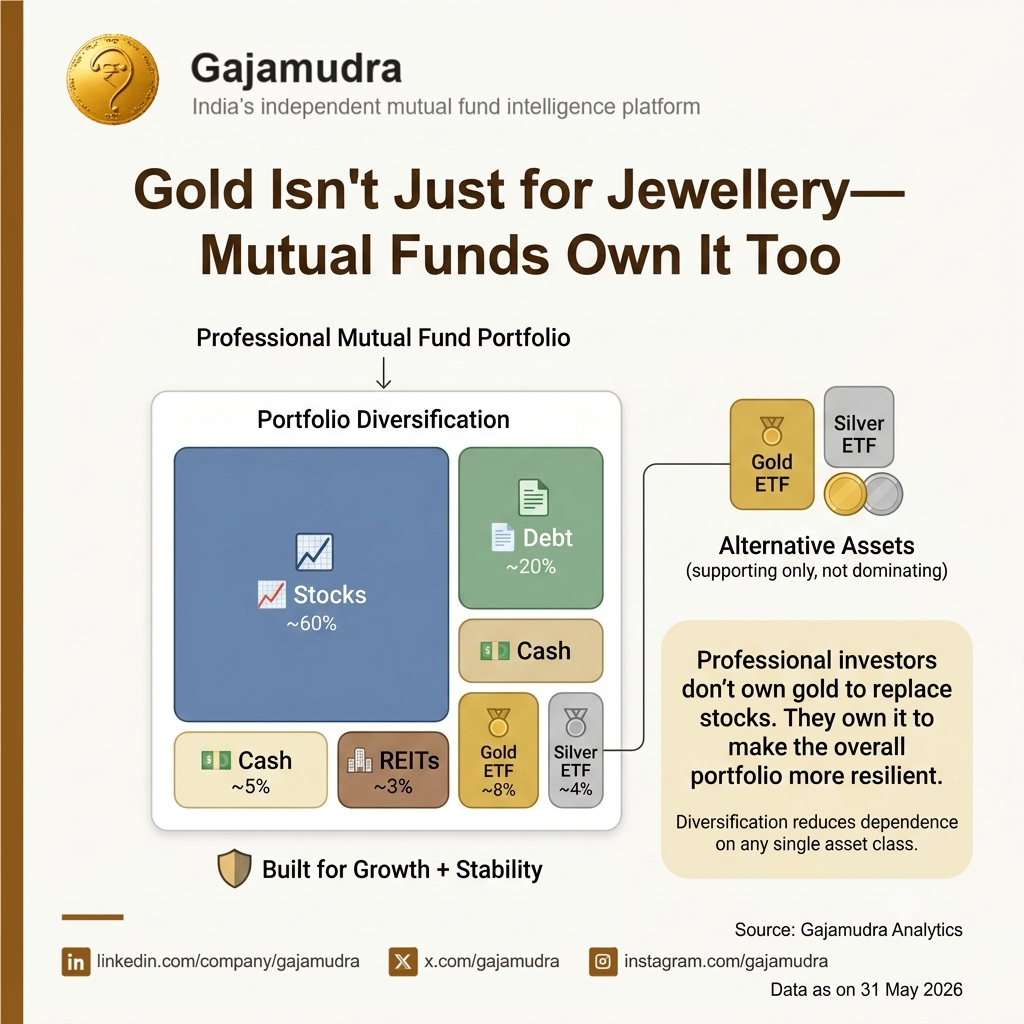
Gold Isn't Replacing Stocks
This is an important point.
Mutual funds are not replacing equities with gold.
In fact, equities remain the biggest part of most portfolios.
Gold usually represents only a small allocation.
Its job isn't to generate the highest return every year.
Its job is to make the overall portfolio more resilient during periods of uncertainty.
That's why many fund managers prefer Gold ETFs instead of buying physical gold.
They're easier to trade, more transparent and fit neatly into a professionally managed portfolio.
The Smallest Holdings Often Tell the Biggest Story
When investors look at a mutual fund portfolio, they usually focus on the largest stocks.
That's natural.
But sometimes, the smaller allocations tell you even more about how the fund manager thinks.
A small investment in gold or silver isn't just another line in a portfolio.
It's a sign that the manager isn't thinking only about growth.
They're thinking about balance.
And that's one of the biggest differences between investing and simply buying stocks.
One Question to Think About
The next time someone says,
"Mutual funds only invest in shares,"
you'll know that's only part of the story.
Because behind every successful portfolio isn't just a search for higher returns.
It's a search for better balance.
That's exactly what Gajamudra Analytics helps investors discover.
Every month, fund managers publish their portfolios.
We help you understand the story those portfolios are telling.
Because every holding has a purpose.
And every portfolio tells a story.