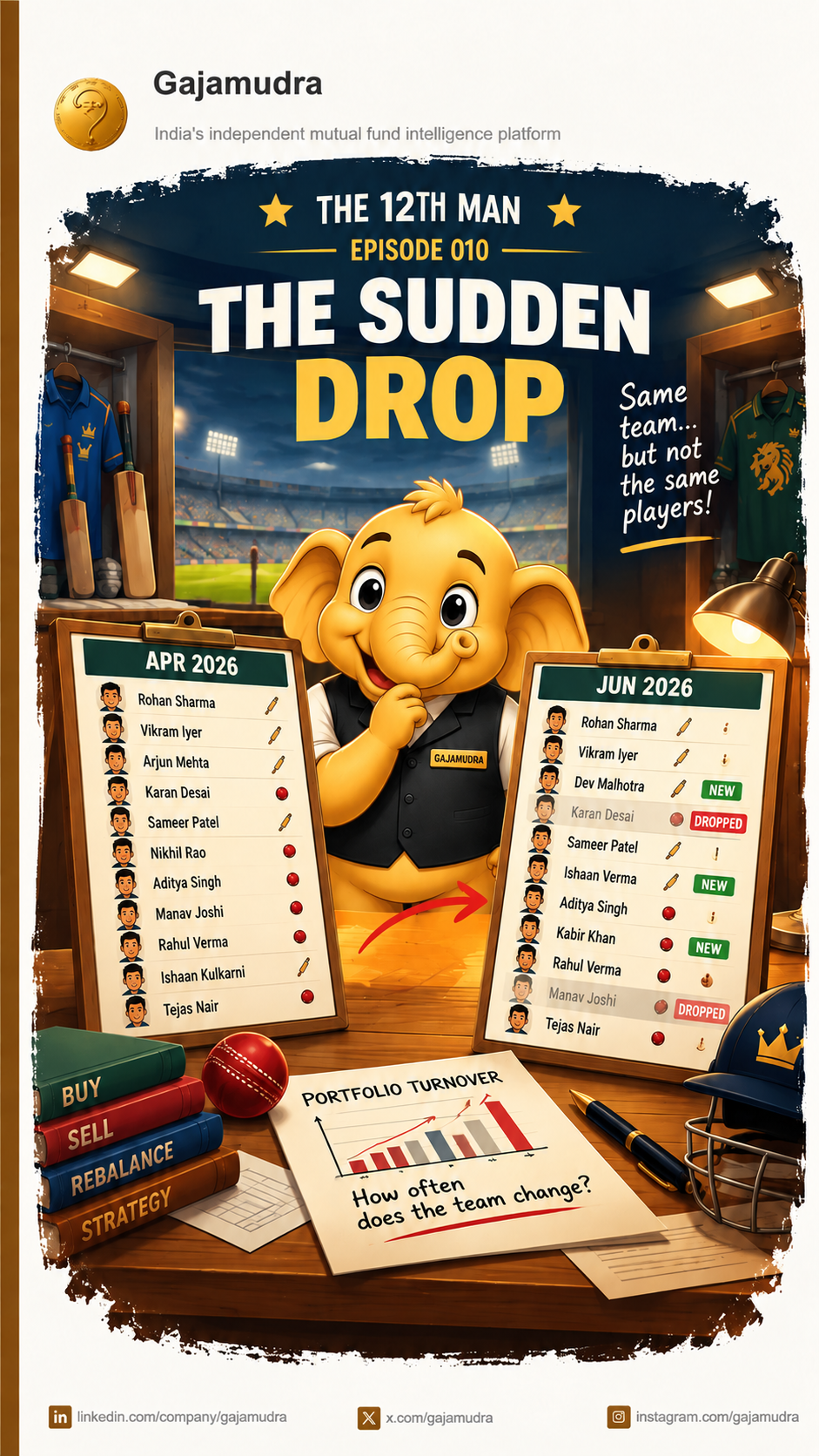
The team sheet arrived.
Everyone expected the usual names.
But one of the captain's favourites was missing.
Last month: Playing.
This month: Dropped.
Then two new names appeared.
The 12th Man looked at both sheets.
“Arre... team itni jaldi kaise badal gayi?” 😳
And that's the real question.
🏏 Welcome to THE 12TH MAN — EPISODE 010
In our cricket universe:
Playing XI = Mutual Fund Portfolio
Stocks can enter.
Stocks can leave.
Weights can change.
Portfolio Turnover tells us how actively a fund's portfolio is being changed through buying and selling.
A team that keeps changing its Playing XI has higher turnover.
A team that sticks with its players has lower turnover.
But:
High turnover ≠ better.
Low turnover ≠ better.
It simply tells you how much the portfolio has been changing.
🏏 The 12th Man Rule
Don't look at one team sheet.
Compare the team sheets over time.
Because a portfolio isn't just a snapshot.
It's a story.
Over to the Dressing Room
Pick a fund.
Compare its holdings across a few months.
Who entered?
Who left?
Who became more important?
That's where the real game begins.
Beyond Returns. Understand What You Own.
🏏 Next Monday — Episode 011
What happens when a small player suddenly becomes the biggest name on the team sheet?
The New Star.
FAQs
1. How is portfolio turnover ratio calculated for a mutual fund?
Portfolio turnover is generally calculated using the lower of purchases or sales divided by the fund's average NAV or corpus over the relevant period. It is intended to measure the level of trading activity within the portfolio.
2. What does a high portfolio turnover ratio mean?
A high portfolio turnover ratio indicates that the fund has experienced relatively more buying and selling activity during the measurement period. It suggests that the portfolio has been changing more actively.
3. What does a low portfolio turnover ratio mean?
A low portfolio turnover ratio generally indicates less trading activity. The fund may be holding its investments for longer periods, although turnover alone does not explain the manager's investment decisions.
4. Does high portfolio turnover mean a mutual fund is actively managed?
Not necessarily. Turnover measures trading activity, not the overall quality or style of management. A fund can have active management decisions without constantly replacing its holdings.
5. Does portfolio turnover affect mutual fund returns?
It can affect costs. Frequent transactions may increase brokerage and other transaction costs, which can reduce returns if the benefits of the trading do not compensate for those costs. SEBI specifically notes the potential impact of higher turnover on transaction costs.
6. Why does a mutual fund buy and sell stocks frequently?
Portfolio changes can happen for several reasons, including changes in investment strategy, market opportunities, portfolio rebalancing, changes in company fundamentals, or changes in the fund's outlook. The turnover ratio itself does not tell you which specific reason caused a trade.
7. Can portfolio turnover change from year to year?
Yes. Turnover can vary considerably between periods because the amount of buying and selling inside a scheme can change with market conditions and portfolio decisions. SEBI notes that turnover can be influenced by market opportunities.
8. How can I compare portfolio turnover between two mutual funds?
Compare the turnover ratios over the same measurement period and preferably between funds with similar investment objectives. Looking at only one year's turnover may not reveal whether a fund's trading activity is normally high or low.
9. Is high portfolio turnover always bad for mutual funds?
No. High turnover is not automatically good or bad. It can create additional transaction costs, but trading may also reflect investment opportunities or portfolio decisions. The relevant question is what the manager's trading achieved after considering its associated costs.
10. Where can I find a mutual fund's portfolio turnover ratio?
Portfolio turnover is commonly available in a mutual fund's factsheet and scheme documents. AMFI lists portfolio turnover among the quantitative measures typically provided in fund factsheets.