The blind men each understood one part of the elephant. Investors can make the same mistake with mutual funds by looking at only one part of the story.
THE SECOND STORY
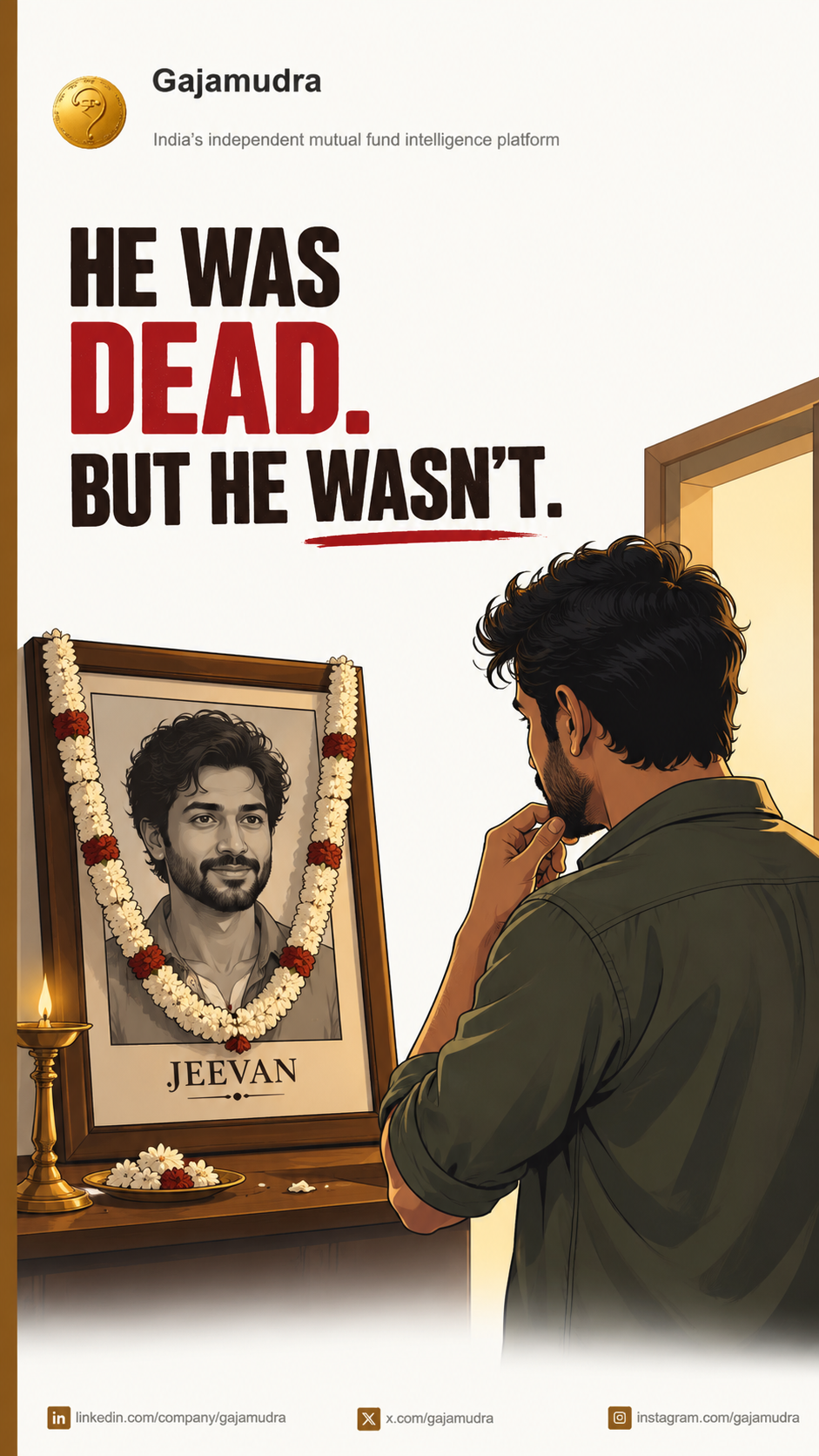
The Man Who Was Dead... But Wasn't
The funeral was over.
The rituals were done.
Everyone believed Jeevan was dead.
Except...
Jeevan himself.
He was very much alive.
The body that had been cremated wasn't his.
It belonged to Bheema —
a stranger who happened to look almost exactly like him.
Jeevan and his wife had found a way to turn that coincidence into a plan.
Make Bheema's death look like Jeevan's.
Collect the insurance money.
And disappear.
For a while...
it worked.
The world saw a dead Jeevan.
The paperwork said one thing.
The reality was something else.
Then the problems began.
Because Bheema wasn't just a lookalike.
He was connected to a completely different world —
diamonds, criminals and a very different story.
And suddenly...
the identity everyone thought they understood
wasn't the identity that actually existed.
That sounds like a movie plot.
But there's a quieter version of this problem in investing.
A mutual fund has a name.
A category.
A rating.
A return.
A fact sheet.
All of these tell you something.
But none of them, alone, tells you the whole story.
Because underneath the name...
are actual companies.
Actual sectors.
Actual weights.
Actual concentration.
And actual changes over time.
A fund may look familiar from the outside.
But its portfolio can tell you something you didn't expect.
That's why looking inside matters.
Gajamudra helps you explore what mutual funds actually own — beyond the name, beyond the rating, and beyond the headline return.
Because sometimes...
what something appears to be
and
what is actually underneath
are two very different things.
The blind men taught us:
One part isn't the whole.
The moth taught us:
Don't chase the shine.
And Jeevan's story teaches us:
Don't mistake the label for the reality.
Look inside.
The story doesn't end here.
Explore more stories, independent research, and what's actually inside India's mutual funds for free at Gajamudra.
Visit Gajamudra → gajamudra.in
Beyond Returns.
Understand What You Own.
1. What is the story behind Jeevan and Bheema?
Jeevan and Bheema are connected through a case of mistaken identity, where one person is made to appear as the other. The story shows how appearances can hide a very different reality.
2. What is the main lesson of the Jeevan and Bheema story?
The story highlights the difference between what something appears to be and what it actually is underneath.
3. How does this story relate to mutual fund investing?
Investors can sometimes judge a mutual fund by its name, returns, rating, or category without examining what the fund actually owns.
4. Why shouldn't investors judge a mutual fund only by its name?
A mutual fund's name tells you what the fund is called, but it does not show all the companies, sectors, concentration, and portfolio changes inside it.
5. Why are mutual fund holdings important?
Holdings show where a mutual fund's money is actually invested. They can provide a deeper understanding of the portfolio beyond headline returns.
6. Is a mutual fund's past return enough to understand the fund?
No. Past returns show how the fund performed, but they do not tell the complete story of its underlying portfolio.
7. Why should investors look beyond mutual fund ratings?
Ratings can be useful as one reference point, but they represent only one part of the picture. Looking at the portfolio can provide additional context.
8. What can investors learn from a mutual fund portfolio?
Investors can examine the companies owned, sector allocation, concentration, and portfolio changes to understand what is inside the fund.
9. What does “look inside your mutual fund” mean?
It means going beyond the fund name and headline performance to examine the actual investments and composition of the portfolio.
10. Can two mutual funds with similar returns have different holdings?
Yes. Two funds can produce similar returns while owning different companies, sectors, and portfolio combinations.
11. Why is understanding what you own important in investing?
Knowing what you own can help you understand where your money is invested and what factors may influence the portfolio.
12. What is mutual fund portfolio analysis?
Mutual fund portfolio analysis involves examining holdings, sector allocation, concentration, portfolio changes, and other characteristics of a fund.
13. What is Gajamudra?
Gajamudra is an independent mutual fund intelligence platform focused on helping investors understand what is inside mutual fund portfolios.
14. How does Gajamudra help investors?
Gajamudra helps investors explore mutual fund holdings and portfolio intelligence beyond headline returns.
15. Can I use Gajamudra to research mutual fund holdings?
Yes. Gajamudra allows investors to explore mutual fund portfolios and investigate what funds actually own.
16. Is Gajamudra a mutual fund recommendation platform?
No. Gajamudra focuses on mutual fund intelligence and research rather than telling investors which funds to buy or sell.
17. Why should investors do independent mutual fund research?
Independent research can help investors look beyond labels, ratings, and recent returns and develop a better understanding of what they actually own.
18. Where can I explore mutual fund research and portfolio intelligence?
You can explore mutual fund research, holdings, and portfolio intelligence on Gajamudra at gajamudra.in.