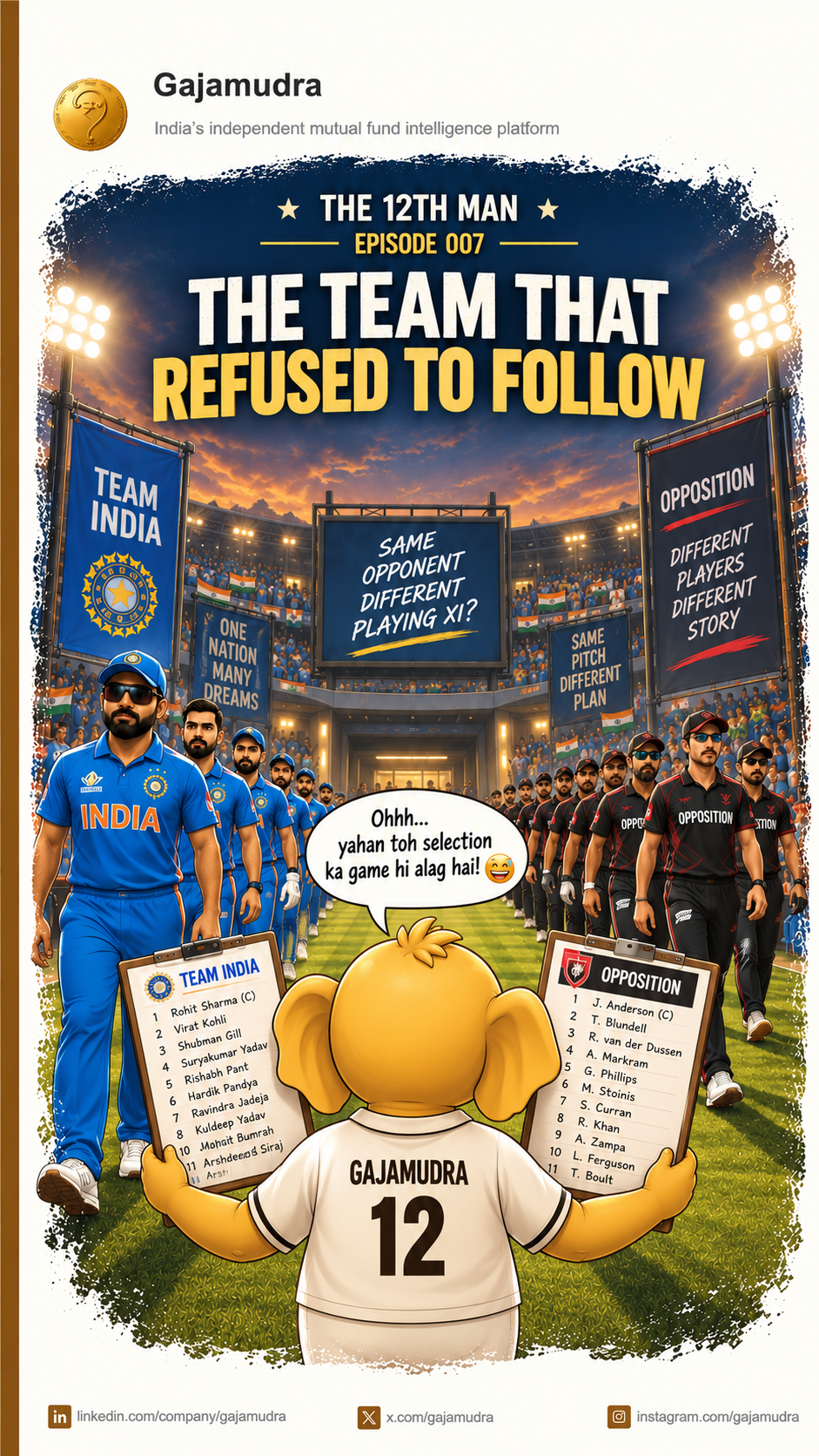
Episode 007 — The Team That Refused To Follow
Every Monday, cricket explains one investing concept.
The dressing room was unusually quiet.
The coach had just received the Playing XI for the biggest match of the season.
Team India.
Everyone knew what that meant.
A packed stadium.
Millions watching.
No room for mistakes.
The coach looked at Team India's sheet.
Then at his own.
Then back at Team India's.
And smiled.
Because something was very different.
The names on his sheet barely matched the names on the other side.
One player was a completely different pick.
Then another.
Then another.
Soon, even the players started noticing.
“Sir... Team India mein toh ye players hain hi nahi.”
The coach nodded.
Exactly.
He wasn't trying to build the same Playing XI.
He had a different combination in mind.
A different way of taking on the same opposition.
And that made the match far more interesting.
When Team India walked out, the stadium erupted.
But when the other team followed, you had to look twice.
This wasn't a copy of the first team.
It was a completely different Playing XI.
And somewhere in the stands, the 12th Man looked at the team sheet again.
“Ohhh... yahan toh selection ka game hi alag hai!” 😄
And that's when the real question appeared.
So... what does this have to do with your mutual fund?
Remember our cricket universe.
Team India = Benchmark
Other team = Mutual Fund
Last week, we met a team that looked almost like Team India.
Same players.
Similar combinations.
Very little difference.
That was index hugging.
But today's team is different.
Very different.
In mutual funds, Active Share helps us understand how different a fund's portfolio is from its benchmark.
It looks at the weights of the holdings in the fund and compares them with the benchmark.
The higher the difference, the higher the Active Share.
The lower the difference, the closer the fund is to its benchmark.
So this time, we're not asking:
“How similar is my team?”
We're asking:
“How different is my team?”
🏏 Think about it like a Playing XI
Imagine two teams preparing for the same match.
One team picks almost all the same players as Team India.
The other picks a very different combination.
Both teams are playing the same match.
Both want to win.
But they're taking very different routes to get there.
That's the basic idea behind Active Share.
It doesn't tell you whether those different choices will win.
It tells you that the manager is making a portfolio that is different from the benchmark.
And that's an important distinction.
Because different doesn't automatically mean better.
Just like picking eleven completely different cricketers doesn't guarantee a victory.
The match still has to be played.
🏟️ The 12th Man Community
And this is where things get interesting for us.
Imagine thousands of 12th Men sitting around the stadium.
One looks at a fund and says:
“This team looks very close to its benchmark.”
Another looks at a different fund:
“Whoa... this Playing XI is completely different.”
Someone asks:
“Why?”
Someone else checks the portfolio.
Another checks what changed since last month.
Now we're not just watching the scoreboard.
We're reading the game.
That's the kind of community we want to build at Gajamudra.
Not a place where someone simply tells you:
“Buy this fund.”
A place where investors become curious about what is actually happening inside their funds.
Gajamudra turns disclosed mutual fund holdings into portfolio analytics, including Active Share, concentration and other measures that help investors look beyond past returns.
Analysis is free.
The community is free.
No hidden charges.
🏏 The 12th Man's Take
Don't just watch the scoreboard.
Look at the Playing XI.
Because the final score tells you what happened.
The Playing XI can tell you something about how the team tried to make it happen.
🎙️ Next Monday
We've seen a team that looked almost identical to its benchmark.
We've now seen one that looked completely different.
But there's another question.
What happens when the captain has 50 players available...
...but keeps betting on the same few?
Episode 008 — The Captain's Favourites.
Sometimes, the Playing XI tells you more than the scoreboard.
🏏 Previous Episodes
Episode 001 — Before The First Ball
https://gajamudra.in/blog.php?slug=cricket
Episode 002 — The Selection Room
https://gajamudra.in/blog.php?slug=the-selection-room-how-fund-managers-choose-stocks-like-cricket-selectors-the-12th-man-episode-002
Episode 003 — The Bigger Stadium
https://gajamudra.in/blog.php?slug=what-is-aum-in-mutual-funds-the-bigger-stadium-the-12th-man-episode-003
Episode 004 — The Scoreboard
https://gajamudra.in/blog.php?slug=what-is-nav-in-mutual-funds-meaning-importance-how-it-works-the-12th-man-004
Episode 005 — A Good Score Needs A Rival
https://gajamudra.in/blog.php?slug=what-is-a-benchmark-in-mutual-funds-the-12th-man-episode-005
Episode 006 — The Team That Plays It Safe
https://gajamudra.in/blog.php?slug=what-is-index-hugging-in-mutual-funds-the-team-that-plays-it-safe-the-12th-man-episode-006-gajamudra
🎙️ Over to the Dressing Room
If your mutual fund were a cricket team, how different would its Playing XI be from its benchmark?
Bring your fund.
Bring your curiosity.
Let's compare Playing XIs.
Gajamudra analysis is free.
The 12th Man community is free.
No hidden charges.
Beyond Returns. Understand What You Own.
🔎 FAQs
1. What is Active Share in mutual funds?
Active Share is a measure of how different a mutual fund's portfolio is from its benchmark. Gajamudra calculates it using the absolute differences between the fund's holding weights and benchmark weights.
2. What does a high Active Share mean?
A high Active Share means the fund's portfolio is substantially different from its benchmark.
In cricket terms, the fund has a very different Playing XI.
It doesn't, by itself, mean the fund will perform better.
3. What does a low Active Share mean?
A low Active Share means the fund's portfolio is relatively close to its benchmark.
In our cricket story, the two Playing XIs look much more alike.
4. Is high Active Share always better?
No.
Active Share measures difference, not investment skill.
A fund can take very different positions from its benchmark and still underperform.
Just because the captain picked a completely different Playing XI doesn't mean his team will win the match.
5. Is Active Share the same as portfolio overlap?
No.
They are related but measure different things.
Portfolio overlap looks at how much two portfolios have in common, while Active Share compares their weights and measures the degree of difference between them. Gajamudra also provides separate Weight Overlap, Jaccard and Cosine measures.
6. Is Active Share only useful for active mutual funds?
Active Share is particularly useful when you're trying to understand how an actively managed fund differs from its benchmark.
It helps answer a simple question:
Is the manager actually making portfolio choices that differ from the benchmark?
7. Does high Active Share guarantee higher returns?
No.
It only tells you that the portfolio is different.
Whether those differences turn out to be good decisions is a completely different question.
8. Why should investors look at Active Share?
Because two funds can both be called actively managed while behaving very differently relative to their benchmarks.
Active Share gives investors another way to look inside the portfolio instead of relying only on historical returns. Gajamudra includes Active Share alongside other portfolio analytics to help make that comparison easier.
9. What is index hugging?
Index hugging describes an active fund whose portfolio stays very close to its benchmark.
In our series:
Episode 006:
“Why does this team look so much like Team India?”
Episode 007:
“How different is this team from Team India?”
10. Where can I check Active Share?
Gajamudra provides a vs-Benchmark Analysis that includes Active Share, Weight Overlap, Cosine similarity and Jaccard similarity against the category benchmark.