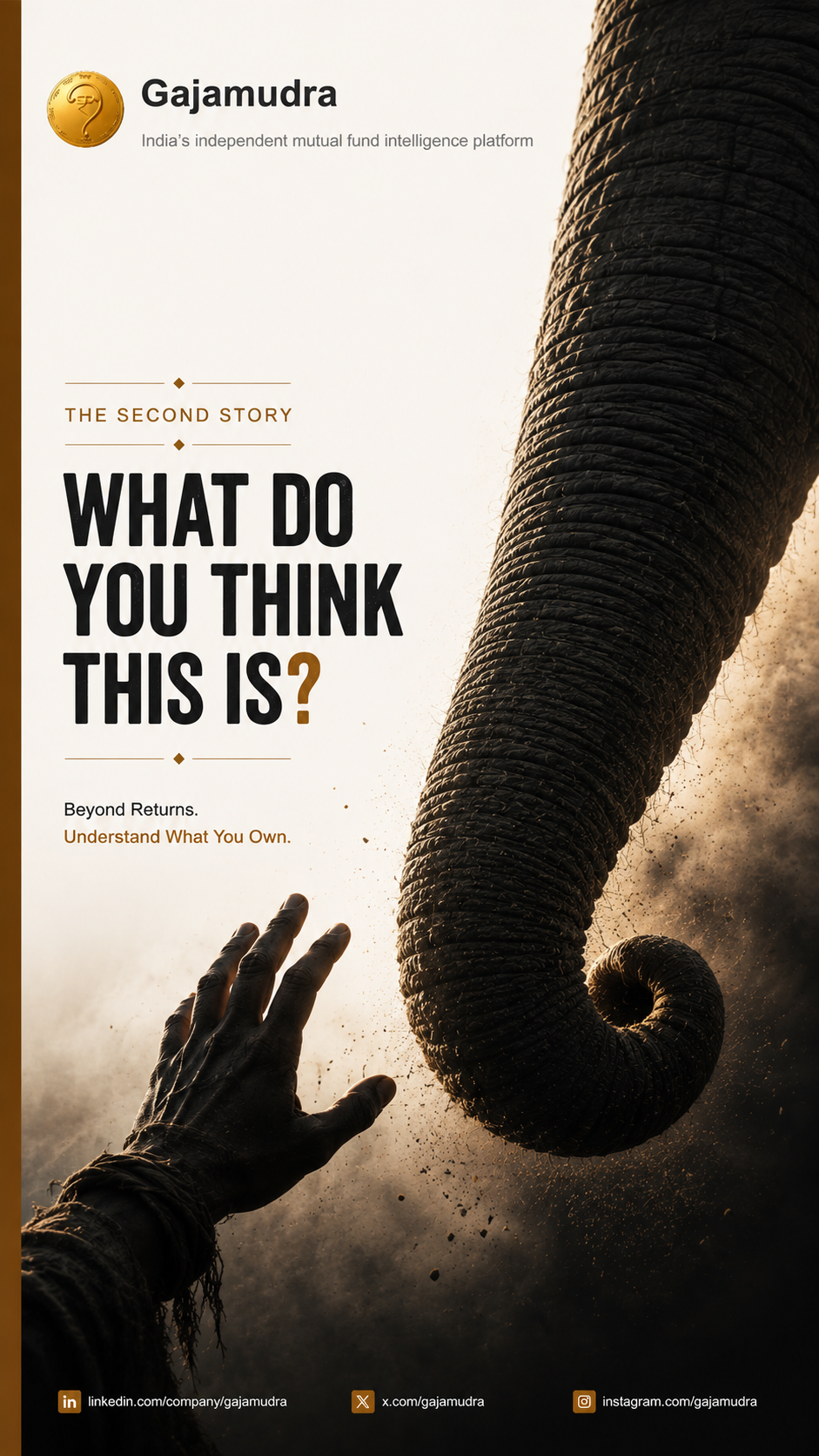
The Blind Men Who All Thought They Were Right
Some stories don't survive because they're old.
They survive...
because every generation keeps proving them true.
One day...
six blind men were brought before an elephant.
None of them had ever seen one.
Each was asked the same question.
"Tell us... what is an elephant?"
The first man touched its trunk.
"It's a snake."
The second grabbed a leg.
"No...
it's a tree."
The third held its ear.
"You're both wrong.
It's a giant fan."
The fourth touched its side.
"It's clearly a wall."
The fifth caught the tail.
"It's a rope."
The sixth held a tusk.
"It's a spear."
Within minutes...
they were arguing.
Each was certain.
Each was sincere.
Each was wrong.
Not because they hadn't observed.
Because they had observed...
only one part.
Sometimes...
investors do the same thing.
One looks only at returns.
Another looks only at ratings.
Another checks only the expense ratio.
Someone else studies only risk.
Another reads only the fact sheet.
Every investor believes they understand the fund.
But they're all touching...
just one part of the elephant.
Understanding a mutual fund isn't about finding one perfect number.
It's about putting the whole picture together.
Returns.
Holdings.
Sector allocation.
Portfolio changes.
Concentration.
Risk.
Only then...
do you begin to understand what you actually own.
Maybe the blind men weren't wrong.
Maybe...
they were simply incomplete.
The same can happen to investors.
Beyond Returns.
Understand What You Own.
FAQs
1. What is the story of the blind men and the elephant?
The story describes six blind men who touch different parts of an elephant and each forms a different idea of what an elephant is. Each person understands one part but misses the complete picture.
2. What is the main lesson of the blind men and elephant story?
The main lesson is that seeing or understanding only one part of something does not necessarily mean you understand the whole.
3. How does the blind men and elephant story relate to investing?
Investors can sometimes focus on a single metric such as returns, ratings, expense ratio, or risk and assume they fully understand a mutual fund. These metrics show different parts of the picture.
4. Why shouldn't investors look only at mutual fund returns?
Returns show what a fund achieved, but they do not explain everything happening inside the portfolio. Looking at holdings, sectors, concentration, and portfolio changes can provide additional context.
5. What should investors look at besides mutual fund returns?
Investors can look at portfolio holdings, sector allocation, concentration, portfolio changes, risk, and other relevant characteristics to develop a broader understanding of a mutual fund.
6. Why are mutual fund holdings important?
Holdings show the companies and securities that make up a mutual fund's portfolio. They can help investors understand where their money is actually invested.
7. What is mutual fund portfolio analysis?
Mutual fund portfolio analysis involves examining a fund's holdings, sector allocation, concentration, portfolio changes, and other characteristics to understand what is inside the fund.
8. What does portfolio concentration mean in mutual funds?
Portfolio concentration refers to how heavily a fund's investments are concentrated in particular companies, sectors, or other areas of the portfolio.
9. Why should investors look at sector allocation?
Sector allocation can show how much of a mutual fund's portfolio is exposed to different industries and help investors understand the broader composition of the fund.
10. Can two mutual funds with similar returns have very different portfolios?
Yes. Two funds can generate similar returns while owning different companies, sectors, and portfolio combinations. Looking beyond returns can reveal these differences.
11. Is a mutual fund rating enough to understand a fund?
A rating can be useful as one data point, but it represents only one part of the overall picture. Investors may also want to examine the underlying portfolio and other characteristics.
12. Why is looking at one mutual fund metric sometimes misleading?
A single metric provides limited information. Like touching only one part of an elephant, relying on one number can create an incomplete understanding of the fund.
13. How can investors understand what their mutual fund actually owns?
Investors can examine the fund's disclosed portfolio holdings, sector allocation, concentration, and changes over time to understand what is actually inside the fund.
14. What is Gajamudra?
Gajamudra is an independent mutual fund intelligence platform focused on helping investors understand what is inside mutual fund portfolios.
15. How does Gajamudra help investors understand mutual fund portfolios?
Gajamudra helps investors explore mutual fund holdings and portfolio intelligence beyond headline returns, making it easier to examine what a fund actually owns.
16. Does Gajamudra provide mutual fund holdings analysis?
Yes. Gajamudra provides tools that allow users to explore mutual fund holdings and analyze different aspects of portfolio composition.
17. Does Gajamudra tell investors which mutual funds to buy?
No. Gajamudra is designed around mutual fund intelligence and portfolio understanding rather than telling investors which funds to buy or sell.
18. Why is it important to understand the whole mutual fund portfolio?
Because no single number tells the complete story. Looking at returns together with holdings, sectors, concentration, portfolio changes, and other information can provide a more complete understanding of what you own.